Uganda
 Kenya
 Rwanda
 Tanzania
BWINDI IMPENETRABLE FOREST NATIONAL PARK
The Bwindi Impenetrable Forest covers 331 square km (128 square mi) located along the eastern border of Democratic Republic of the Congo. A montane (junction of mountain and plane forest) forest with coniferous and broad leaf forest with a lot of moss. Many parts of the park are accessible only by foot due to this thick growth.
The forest, known as one of the richest ecosystems in Africa, is home to 120 varieties of mammals, 348 species of birds, 220 different types of butterflies, and 27 sorts of frogs, chameleons, and geckos. Along with this there are 1,000 different flowering plants, 163 species trees, and 104 types of ferns.
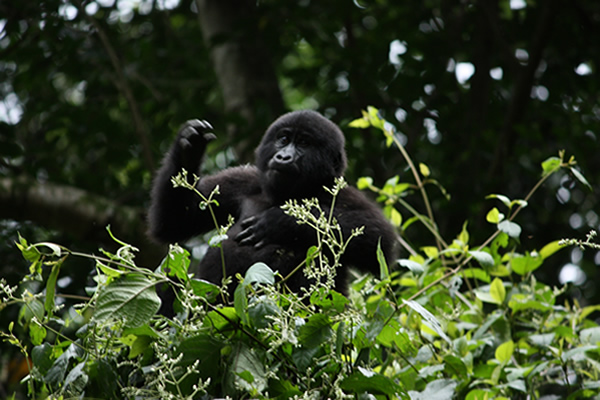
Bwindi Impenetrable Forest National Park is a sanctuary for the colobus monkey, chimpanzee, and many birds such as the hornbills, African green broadbill, the Green breasted Pitta and turacos. There are 340 Bwindi gorillas which make up half of the world’s endangered mountain gorillas. From this there are 14 habituated groups open to tourists with Mubare group being the first group habituated.
History at a glance:
- 1932 – Two blocks of land were designated as the Crown forest Reserve – Kayonza Crown Forest Reserve to the north and Kasatora Crown Forest Reserve to the south. 207 square km
- 1942 -The two forest reserves were combined, enlarged, and given a new name, Impentetrable Central Crown Forest. 298 square km.
- 1964 – Designated as an animal sanctuary providing protection to gorillas and was again renamed Impenetrable Central Forest Reserve.
- 1966 – Two other forest reserves became part of the Impenetrable Forest increasing the size to 321 square km
- 1991 – Impenetrable Central Forest Reserve, along with Mgahinga Gorilla Reserve and Rwenzori Mountains Reserve are designated as National Parks. The name is changed to Bwindi Impenetrable Forest National Park.
- 1993 – Gorilla tracking becomes a popular tourist activity
- 2003 – The land next to the park is purchased and incorporated adding 4.2 square km.